
Introduction
Buying an open plot or investing in a real estate project is an important financial decision. Many people invest their hard-earned money in land because they expect long-term value, future development, and financial security. However, a lack of proper verification can expose buyers to fraudulent sellers, disputed land, unauthorized layouts, and misleading investment promises.
If you are planning to buy open plots in Hyderabad or nearby locations such as Shadnagar, Shankarpally, Yadadri, or other developing areas, you should carefully verify the project before paying any advance.
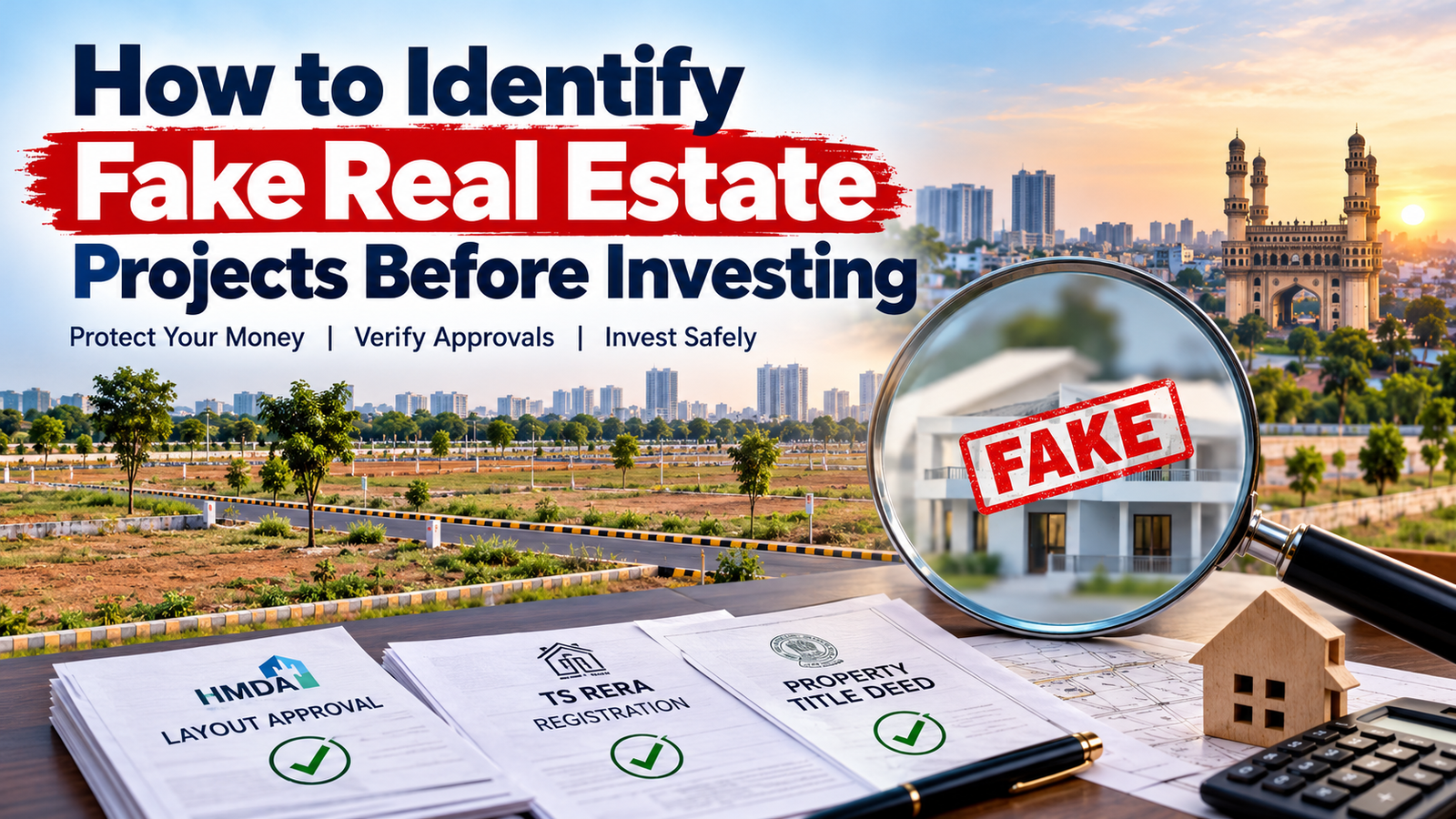
Learning how to identify fake real estate projects can help you recognize warning signs, verify essential documents, and make a more informed investment decision.
In this guide, DigitalPlots.site explains the practical steps every property buyer should follow before investing in a real estate project in Telangana.
Table of Contents
1. Verify the Telangana RERA Registration
One of the first steps when evaluating a real estate project is to check whether it requires registration with the Telangana Real Estate Regulatory Authority (TGRERA) and whether that registration is valid.
RERA is designed to improve transparency and protect buyers in covered real estate projects. However, a registration number displayed in an advertisement should never be accepted without verification.
How to check RERA registration
- Visit the official Telangana RERA website.
- Open the project search section.
- Search using the project name, promoter name, or registration number.
- Compare the official record with the details provided by the developer.
- Review available registration details, project status, completion information, and relevant certificates.
Pay attention to differences in the project name, developer’s legal name, survey numbers, and location.
If a developer refuses to provide a registration number for a project that requires registration, treat this as a warning sign and seek clarification from the authority or a qualified property lawyer.
Important: Not every real estate transaction or plotted development is necessarily subject to RERA registration. Applicability depends on the law and the project’s circumstances. Verify the requirement rather than assuming that registration is always mandatory.
2. Check HMDA or Relevant Layout Approval
Buyers searching for HMDA-approved plots in Hyderabad should verify the actual layout permission instead of relying only on promotional banners.
A developer may advertise a project as approved even when the approval is incomplete, relates to a different survey number, or does not cover the plots being offered.
Where to verify layout permissions
Use the official resources below:
- Hyderabad Metropolitan Development Authority (HMDA)
- HMDA Layout Permission Reports
- Telangana BuildNow Portal
The relevant approving authority depends on the location of the land. Depending on the jurisdiction, this may involve HMDA, DTCP, or another competent planning authority.
What should you verify?
- Layout permission number and date.
- Final approval status, where applicable.
- Survey numbers and village details.
- Approved layout plan and plot numbering.
- Roads, open spaces, and other designated areas.
- Whether the advertised plot falls within the approved layout.
Do not assume that a draft approval or an application receipt is equivalent to final layout approval. Ask the relevant authority to clarify the project’s actual permission status.
3. Verify Land Ownership and Property Documents
A project may have attractive roads, marketing offices, and impressive brochures, but these features do not establish legal ownership.
Before purchasing land, verify who legally owns the property and whether the seller has the authority to transfer it.
Request copies of the relevant documents, including:
- Parent documents and previous title deeds.
- Current title deed.
- Encumbrance Certificate (EC).
- Survey number and land extent details.
- Revenue records and applicable land records.
- Mutation records, where relevant.
- Legal heir, succession, or partition documents, if applicable.
- Required development permissions and approvals.
You can begin checking relevant Telangana land records through the official Bhu Bharati portal.
For registered document details, you can also consult the Telangana Bhu Bharati registered document service.
Remember that online revenue records and an Encumbrance Certificate alone do not conclusively establish clear ownership. A qualified property lawyer should examine the title chain and other relevant records.
Read our guide on How to Verify Land Documents Before Buying a Plot to understand the essential property documents to check before investing.
4. Watch Out for Extremely Low Prices
An unusually low price can make a property seem like an excellent investment. However, an offer significantly below comparable properties in the same location deserves careful investigation.
For example, if similar plots are being offered for ₹25,000 per square yard and another seller advertises plots for ₹10,000 per square yard, ask why the difference exists.
Possible explanations may include differences in location, access roads, approval status, infrastructure, ownership, or payment conditions. Some offers may also use misleading promotional prices to attract buyers.
How to protect yourself
Compare at least three to five comparable properties. Consider the exact location, plot size, road access, approval status, infrastructure, and transaction terms.
Ask for a written quotation that explains the total price, registration-related costs, development charges, maintenance charges, and any additional payments.
Never transfer money solely because a salesperson claims that the price will increase tomorrow or that only one plot remains available.
5. Visit the Actual Property Location
Never make a significant property investment based entirely on online advertisements, WhatsApp messages, videos, or photographs.
Visit the site personally before making a decision.
During the visit, check whether the land matches the location shown in the documents. Confirm the survey numbers with the assistance of a qualified surveyor or relevant professional.
Look for access roads, physical boundaries, drainage, electricity arrangements, nearby development, and possible signs of encroachment.
Ask the developer to identify your specific plot on the approved layout plan. Check whether its dimensions and location match the sale documents.
If the seller refuses to arrange a site visit or repeatedly provides excuses, investigate further before proceeding.
A site visit is essential, but it does not replace legal verification. A well-developed site can still have ownership or approval problems.
6. Investigate the Developer’s Background
Before investing, research the developer or real estate company responsible for the project.
A professional-looking website, office, logo, or social media account does not prove that a company is trustworthy.
Check the company’s legal name, business address, project history, and the identity of the person authorized to sign the sale agreement.
Search for credible information about previous projects, delays, complaints, litigation, or regulatory orders. Where relevant, check the developer’s registration details and any available TGRERA records.
Speak to previous customers if possible. Ask about promised facilities, documentation, possession timelines, and whether the actual development matched the original commitments.
Be cautious if the company frequently changes its name, avoids written communication, or cannot explain who owns the land.
A positive reputation can be useful, but every individual project must be verified separately.
7. Never Trust Verbal Promises Alone
Some property salespeople make attractive promises to close a deal quickly. These may include guaranteed returns, assured resale, immediate appreciation, or promises that all approvals will arrive shortly.
Verbal statements are difficult to rely on when a dispute occurs.
Ask for all important representations to be documented in the sale agreement or other legally appropriate written documents.
Carefully review the payment schedule, completion obligations, refund provisions, plot identification, applicable approvals, and consequences of a breach.
If the seller promises a clubhouse, a wide road, electricity, drainage, or other facilities, check whether those commitments are properly documented and consistent with the approved plans.
Have an independent lawyer review the agreement before signing. Do not rely exclusively on a lawyer or consultant selected by the seller.
8. Avoid Paying Money to Unverified Accounts
Payment fraud is another risk when purchasing property.
A genuine-looking advertisement or sales representative may ask buyers to transfer booking money to an individual’s personal bank account, a different company’s account, or an unfamiliar UPI ID.
Before making any payment, verify the recipient’s identity and authority to receive the money.
Follow these precautions:
- Obtain a written booking form or agreement.
- Confirm the payment instructions directly with the verified developer.
- Check that the recipient’s name matches the documented transaction arrangements.
- Request an official receipt for every payment.
- Avoid cash transactions that cannot be properly documented.
- Never share OTPs, banking passwords, or UPI PINs with sales representatives.
- Do not sign blank documents or leave important details incomplete.
If you suspect that money has been obtained through fraud, preserve messages, receipts, bank details, advertisements, and agreements. Report suspected cyber-enabled financial fraud promptly through India’s National Cyber Crime Reporting Portal or call 1930 for urgent reporting of cyber financial fraud.
9. Understand the Difference Between Approval and Ownership
One common mistake is assuming that a project with a layout approval must automatically have a clear title.
These are different issues.
Layout approval concerns the development permission granted by the competent planning authority. Ownership verification concerns whether the seller has a valid legal right to sell the land.
Similarly, RERA registration, where applicable, does not replace independent title verification or guarantee investment returns.
Before purchasing a plot, verify both the project’s approval status and the ownership documents.
Also investigate whether the land is affected by litigation, acquisition, government restrictions, prohibited transfer rules, or other legal issues.
The exact checks required depend on the property’s location, land classification, and transaction history. Independent legal advice is especially important when the land has complicated ownership records.
10. Review the Complete Investment Cost
A low advertised price does not always represent the complete cost of buying a property.
Ask for a written breakdown of the total amount payable.
Consider the plot price, applicable stamp duty and registration charges, development charges, maintenance fees, taxes where applicable, and any other contractual costs.
Do not assume that every promised facility will be delivered without additional expense.
Also consider whether the plot has suitable road access and whether the proposed use is consistent with applicable planning rules.
Avoid investing money that you may need immediately for essential expenses. Land can be difficult to sell quickly, and future appreciation is never guaranteed.
A sensible investment decision should be based on verified documents, a realistic budget, and your own financial circumstances rather than pressure from salespeople.
11. What Should You Do If You Suspect a Fake Project?
If you find inconsistencies in the documents or suspect that a developer is misleading buyers, do not rush to pay an advance.
First, collect copies of the advertisements, agreements, receipts, project brochures, messages, approval documents, and other available evidence.
Next, seek advice from an independent property lawyer. Depending on the issue, you may contact TGRERA, the relevant planning authority, the local police, or the appropriate consumer grievance authority.
For relevant real estate regulatory issues, visit the official Telangana RERA website.
For suspected online payment fraud, use India’s National Cyber Crime Reporting Portal.
If you have already paid money, contact your bank promptly when a suspicious transaction is involved. The correct complaint process will depend on the facts and the nature of the dispute.
Do not make public accusations against a company without reliable evidence. Focus on preserving records and reporting the matter through appropriate channels.
Conclusion
Learning how to identify fake real estate projects before investing can help you avoid preventable risks and make better property decisions.
Always verify the developer, land ownership, relevant layout approvals, RERA applicability, and the actual property location. Review all payment