
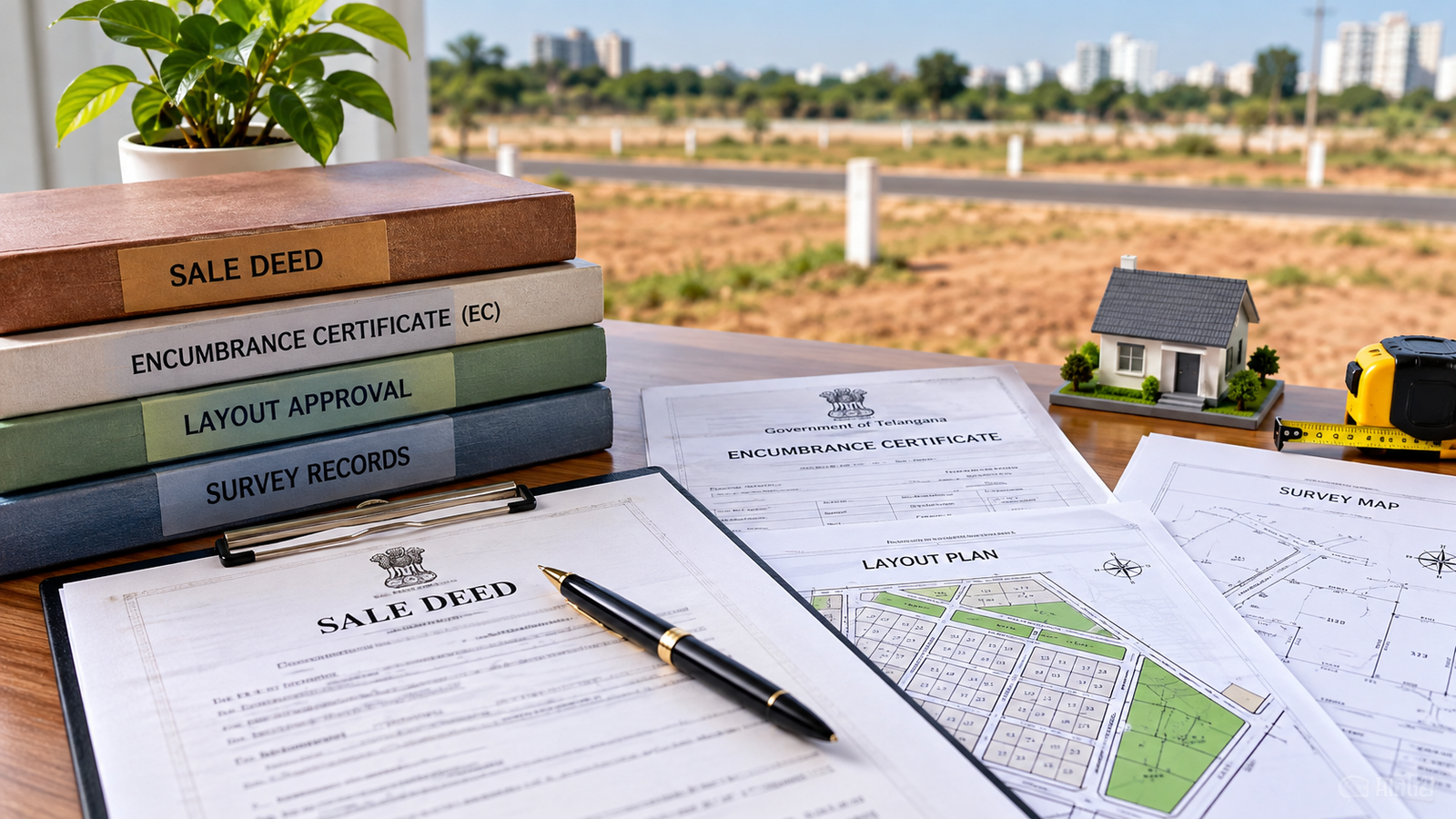
Buying a plot is an important decision that requires careful research and document verification. Whether you are planning to purchase land in Hyderabad, Shadnagar, Sangareddy, Yadadri, or another part of Telangana, checking the property’s legal documents should be one of your first priorities.
Many buyers focus mainly on the location, price, road access, and future development potential. However, understanding the ownership history, checking government records, and confirming layout approvals are equally important.
Knowing how to verify land documents can help buyers identify discrepancies, understand potential legal risks, and make more informed decisions before paying an advance or signing an agreement.
In this guide, we explain the essential documents to check, the official government websites to use, and the steps to follow before purchasing an open plot in Telangana.
Table of Contents
Why Is It Important to Verify Land Documents?
Land transactions involve several legal and administrative records. A property may be advertised as approved, legally clear, or ready for registration, but buyers should independently verify these claims.
Proper land document verification can help you identify:
- Differences between the seller’s name and ownership records.
- Existing mortgages or registered transactions affecting the property.
- Discrepancies in survey numbers, boundaries, and plot measurements.
- Missing or questionable layout permissions.
- Potential disputes involving ownership or inheritance.
- Restrictions affecting the property’s permitted use.
Remember that no single certificate guarantees that a property is completely free from every legal issue. The safest approach is to verify land documents through official records and obtain an independent legal opinion.
1. Check the Original Title Deed
The title deed is one of the most important documents in a property transaction. It records the transfer of ownership through a legally recognised transaction, subject to the applicable law and the facts of the case.
Ask the seller to provide the relevant original registered sale deed and supporting ownership documents.
Check the following details:
- Name and identity of the registered owner.
- Document number, registration year, and Sub-Registrar Office.
- Survey number and extent of the land.
- Property boundaries and location.
- Details of the previous transaction.
- Any conditions or limitations mentioned in the deed.
Compare these details with the documents provided by the seller and the information available in official registration records.
For inherited property, request the relevant succession, inheritance, partition, or other supporting documents, as applicable.
Important: A registered sale deed alone may not establish an unchallengeable title. Ask a property lawyer to examine the ownership chain and determine whether the seller has the legal right to transfer the property.
2. Obtain an Encumbrance Certificate (EC)
An Encumbrance Certificate, commonly called an EC, is an important part of the process to verify land documents.
It provides information about registered transactions and encumbrances recorded against a property for the period covered by the search.
For example, it may help identify registered sales, mortgages, or other recorded transactions affecting the property.
How to check an EC in Telangana
- Visit the Telangana State Government portal.
- Find the Registration and Stamps Department services.
- Locate the Encumbrance Certificate service.
- Provide the required property and registration details.
- Request the certificate for an appropriate period.
- Compare the certificate with the title deed and other available records.
You can also review the National Government Services Portal’s Telangana EC service information.
What should buyers look for?
Check whether the EC reveals registered transactions that are inconsistent with the seller’s claims. Confirm that the property identifiers match the documents under review.
An EC has limitations. It may not reveal unregistered arrangements, every pending dispute, or every possible claim affecting ownership. Therefore, obtaining an EC should be only one part of the process to verify land documents.
3. Verify HMDA or Other Applicable Layout Approval
If you are purchasing a plot in the Hyderabad Metropolitan Region, determine which planning authority has jurisdiction over the property.
Depending on the location, the relevant authority may be HMDA, DTCP, GHMC, or another competent local authority.
Do not assume that every plot near Hyderabad falls under HMDA jurisdiction.
How to verify HMDA layout approval
- Ask the seller or developer for the layout permission number.
- Request the approved layout plan and permission proceedings.
- Check the survey numbers and village details.
- Confirm the plot number and boundaries against the approved plan.
- Verify the approval details with the relevant planning authority.
- Check whether any conditions or subsequent orders affect the approval.
Visit the official HMDA website and its Planning Department page to access planning-related information.
If the property falls outside HMDA jurisdiction, contact the appropriate authority instead.
Why is layout approval important?
A layout permission relates to the development plan and the approved arrangement of plots, roads, and other designated areas. A plot advertised as approved should be checked against the actual permission and plan.
Do not rely only on a brochure, a signboard, or a photocopy provided by an agent.
Also, remember that layout approval and clear ownership are different matters. You must verify both.
4. Check Telangana RERA Registration Where Applicable
The Real Estate (Regulation and Development) Act, 2016, established a regulatory framework for qualifying real estate projects and other covered activities.
Depending on the project’s nature, size, and applicable exemptions, registration with the Telangana Real Estate Regulatory Authority (TG RERA) may be required.
How to check RERA registration
- Visit the official Telangana RERA website.
- Look for the project search or registration information.
- Search using the project name, promoter name, or registration number.
- Compare the displayed details with the developer’s advertisements and documents.
- Review available project information and relevant orders or disclosures.
Check whether the project details correspond to the property being offered to you.
A RERA registration number should not be treated as a substitute for examining the title deed, layout permission, and other land records.
For individual resale plots or projects that may fall within an exemption, consult a qualified professional to determine which requirements apply.
5. Verify Survey Numbers and Revenue Records
Survey numbers help identify a parcel of land in official land and cadastral records. Incorrect or inconsistent survey details can create confusion about the property being sold.
Ask for the relevant survey records, land extent details, cadastral map or survey sketch, and revenue records applicable to the property.
Depending on the nature of the land, these may include records relating to ownership, mutation, land classification, and other revenue entries.
Use the Telangana State Government services portal to locate relevant revenue services.
Details to compare
- Village and mandal.
- Survey number and subdivision number, if any.
- Recorded land extent.
- Owner or pattadar details, where applicable.
- Land classification and recorded use.
- Boundaries and adjoining parcels.
Revenue records can be useful evidence, but an entry in a revenue record is not always conclusive proof of legal title.
If the records conflict with the registered deed, ask a property lawyer and the appropriate revenue authority to clarify the discrepancy before proceeding.
6. Check the Seller’s Identity and Legal Authority
Before purchasing a plot, verify that the person offering the property is legally entitled to sell it.
Ask the seller for appropriate identity documents and compare the name with the registered ownership documents.
If the property has multiple owners, determine whether all required owners must participate in the transaction.
For inherited property, examine the relevant succession and ownership documents. For a company-owned property, check the company’s authority to execute the transaction.
If someone is selling on behalf of the owner through a Power of Attorney, have a lawyer verify the document’s validity, scope, and enforceability for the proposed transaction.
Be especially careful if the seller refuses to provide supporting documents or pressures you to pay immediately.
7. Check for Loans, Mortgages, and Legal Disputes
Another important step when you verify land documents is to investigate possible financial claims and disputes.
An EC may disclose certain registered mortgages and transactions, but it does not replace a comprehensive legal investigation.
Ask your lawyer to check the available records for:
- Existing mortgages or charges.
- Pending or previous court cases affecting the property.
- Competing ownership claims.
- Acquisition notifications or other restrictions.
- Easements, access rights, or boundary disputes.
- Relevant orders or prohibitions affecting transfer.
Where necessary, the lawyer can identify appropriate court searches, registration records, and other official sources.
If a mortgage exists, do not assume that the seller can transfer the plot free from that liability simply because they promise to clear it later. Obtain appropriate documentation and legal advice before proceeding.
8. Inspect the Plot and Confirm Its Boundaries
Paperwork is essential, but the physical property must also be checked.
Visit the actual site and compare it with the approved layout and property documents.
Confirm the location, plot number, dimensions, road access, neighbouring plots, and visible boundary markers.
Where boundaries or measurements are unclear, arrange for a qualified surveyor to inspect the property and compare the findings with the relevant records.
Also investigate practical concerns such as access roads, drainage, water availability, and any visible encroachments.
If the plot’s physical location does not match the documents, pause the transaction until the discrepancy has been resolved.
9. Check Land Use and Applicable Restrictions
Before finalising the purchase, establish whether the property can lawfully be used for your intended purpose.
A parcel of land may be affected by its recorded classification, master-plan designation, planning conditions, environmental restrictions, or other legal requirements.
For a proposed residential plot, check the applicable land-use information and approved layout details with the competent authority.
The HMDA website provides planning-related information for its jurisdiction. If another authority controls the property, seek the corresponding records from that authority.
Do not assume that land can automatically be used for residential construction simply because nearby properties have houses or because the seller describes it as residential land.
10. Get an Independent Legal Opinion Before Paying
Even after you verify land documents, an independent legal review is strongly recommended.
A property lawyer can examine the chain of title, registered deeds, EC, revenue records, layout permissions, seller’s authority, and any potential restrictions.
The lawyer may also recommend additional documents based on the property’s history and location.
Before making a substantial payment, ensure that the sale agreement accurately describes the property, agreed price, payment terms, completion conditions, and the parties’ obligations.
Use traceable payment methods and retain copies of receipts and signed documents.
Avoid proceeding solely on verbal assurances, promises of future approvals, or claims that registration alone will resolve every legal issue.
Land Document Verification Checklist
Use this checklist before deciding whether to proceed with a plot purchase.
- Original registered title deed and supporting ownership documents checked.
- Ownership history reviewed by a property lawyer.
- EC obtained for an appropriate period and reviewed.
- Survey numbers, land extent, and boundaries matched.
- HMDA or other applicable layout approval independently verified.
- TG RERA registration checked where applicable.
- Seller’s identity and authority to sell verified.
- Mortgages, disputes, acquisition issues, and restrictions investigated.
- Physical site inspection and boundary verification completed.
- Land use and relevant planning conditions checked.
- Independent legal opinion obtained before proceeding.
The documents required can vary depending on whether the land is agricultural, converted land, an approved residential plot, inherited property, or a resale plot.
Conclusion
Learning how to verify land documents is an essential part of making an informed property decision. Reviewing the title deed, obtaining an EC, checking applicable layout permissions, examining revenue records, and confirming the seller’s legal authority can help you identify potential problems before committing money.
For buyers considering plots in Hyderabad and surrounding areas, official government records should be the starting point rather than relying only on marketing material or verbal assurances.
Remember that an approved layout does not automatically establish clear ownership, and an EC alone cannot rule out every legal risk. A complete review should combine document checks, site inspection, official verification, and independent legal advice.
Visit DigitalPlots.site for more information and educational resources related to real estate and plot purchasing. Take time to verify land documents carefully before making a final decision.
Frequently Asked Questions (FAQs)
1. How can I verify land documents before buying a plot in Telangana?
Start by examining the registered title deed, obtaining an EC, checking the applicable layout approval, reviewing survey and revenue records, and confirming the seller’s legal authority. Ask an independent property lawyer to review the documents before proceeding.
2. Is an Encumbrance Certificate enough to prove that land is legally clear?
No. An EC provides information about registered transactions and encumbrances for the period searched. It may not disclose every possible dispute, unregistered claim, or ownership defect. A broader legal review is necessary.
3. How can I check whether a plot is HMDA approved?
Obtain the layout permission number and approved plan from the seller. Verify the details through the official HMDA website or the competent planning authority for that location. Match the plot and survey numbers with the approved records.
4. Is RERA registration mandatory for every plot?
Not necessarily. Applicability depends on the project’s nature, size, legal status, and relevant exemptions. Check the TG RERA website and seek professional advice if you are unsure whether registration is required.
5. Can I buy a plot if the seller does not have the original documents?
Do not proceed without investigating why the originals are unavailable. A lawyer should examine certified copies, registration records, ownership history, and any circumstances involving lost or retained documents before advising you on the transaction.
6. What should I do if the survey number differs between documents?
Pause the transaction and have a property lawyer and the relevant survey or revenue authority investigate the mismatch. Do not assume the discrepancy is harmless until the property’s identity and boundaries have been established.
7. Should I consult a lawyer before buying an open plot?
Yes. An independent property lawyer can review the title history, EC, approvals, seller’s authority, and possible legal restrictions. This provides a more comprehensive assessment than checking individual certificates alone.
Disclaimer: This article is for general educational purposes only and is not legal advice. Document requirements and approval procedures vary by property and jurisdiction. Consult a qualified property lawyer and the relevant government authorities before entering into a transaction